Microbial Interations
Biological Interactions
With the development of microbial communities, the demand for nutrients and space also increases. As a result,
there has been a development of different strategies to enable microorganisms to persist in an
environment. Cell–cell interactions may produce cooperative effects where one or more individuals
benefit, or competition between the cells may occur with an adverse effect on one or more species in the environment. The
nature and magnitude of interaction
will depend on the types of microorganism present as well as the abundance of
the microorganisms and types of sensory systems of the individual
organisms.
Classification of microbial interactions
In addressing microbe–microbe interactions, it is
important to determine whether the interaction
is between cells of different genera or within the same species.
Various types of interaction of a microorganism with another microorganism and specific examples of the processes associated with
microbe–microbe interaction are presented in table 1 and 2.
Table 1: Types of Interaction between
Microorganisms and Hosts
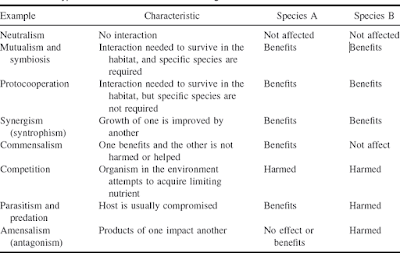
Microorganisms can be physically associated with other organisms in a number of ways
·
Ectosymbiosis-microorganism remains outside the other organism
·
Endosymbiosis-microorganism is found within the other
organism
·
Ecto/endosymbiosis-microorganism lives both on the
inside and the outside of the other organism
·
Physical associations can be
intermittent and cyclic
or permanent
Table 2: Examples of Microbial Interactions

a – plant microbe
interaction; b - animal microbe
interaction
Neutralism
Neutralism occurs when microorganisms have no effect on
each other despite their growth in fairly
close contact. It is perhaps possible for neutralism to occur in natural
communities if the culture density is
low, the nutrient level is high, and each culture has distinct requirements for growth. It has been suggested that
neutralism may occur in early colonization of an environment without
either harmful or beneficial interactions by the microorganisms introduced.
Microbe-Microbe Interactions
1. Positive interaction: Beneficial Interactions
Some interactions provide benefits to the different partners.
(1) Mutualism (2) Protocooperation and (3) Commensalism
2. Negative interaction: Conflictual Interactions
(1) Predation (2) Parasitism and (3) Amensalism (4) Competition

Figure: Microbial Interactions: Basic characteristics of positive (+) and negative (-) interactions that can occur between different organisms
Symbiotic associations
The term symbiosis has been used to characterize various
situations where different species are found
living together. In the broadest definition, symbiosis has been used to
describe biological interactions known as mutualism, commensalisms, and parasitism.
Obligate versus facultative
Relationships can be obligate, meaning that one or both of the
symbionts entirely depend on each other for survival.
They cannot survive without each other.
Relationship may be facultative, meaning
that one or both of the symbionts
are not entirely
depend on each other and they may live independently.
1.
Positive interaction: Beneficial Interactions
Mutualism
Mutualism defines as an obligatory association that
provides some reciprocal benefit to both partners.
This is an obligatory relationship in which the mutualist and the host are
metabolically dependent on each other.
Lichen is an excellent example
of microbe-microbe mutualism
interaction. Lichen is the association between specific ascomycetes
(the fungus) and certain genera of either green algae or cyanobacteria. In a lichen, the fungal partner is termed the
mycobiont. Algal photobionts are called phycobionts and cyanobacteria photobionts are called cyanobionts.
The fungi benefit
for the carbohydrates produced by the algae or cyanobacteria via photosynthesis.
The fungus obtains nutrients from its partner by haustoria (projections of
fungal hyphae) that penetrate the
phycobiont cell wall. It also uses the O2 produced during phycobiont photophosphorylation in carrying out respiration.
The fungus provides space for algae or cyanobacteria by
creating a firm substratum within which the
phycobiont can grow. It also protects the phycobiont from excess light
intensities and other environmental stress.
Protocooperation (Synergism)
An example of this type of relationship is the
association of Cellulomonas and Azotobacter.
Azotobacter uses glucose
provided by a cellulose-degrading microorganism such as Cellulomonas, which uses the nitrogen fixed by
Azotobacter.
Another
example of this type of relationship is the association of Desulfovibrio and
Chromatium, in which the carbon and sulfur cycles are linked. The organic matter (OM) and sulfate required
by Desulfovibrio are produced by the Chromatium while reduction of CO2
to organic matter and oxidation of sulfide to sulfate required to Chromatium carried out by Desulfovibrio.


Fig. 2: Examples of Protocooperative Symbiotic Processes
Syntrophism is a protocooperative symbiotic process in
which phototrophic and chemotrophic bacteria not only exchange
metabolites but also interact at the
level of growth coordination.
Commensalism
The commensalistic relationship involves two microorganisms where one partner
(the commensal) benefits while the other species
(the host) is not harmed or helped.
There are several situations under which commensalisms may occur between
microorganisms
(1)
Commensalistic relationships between microorganisms include
situations in which the waste
product of one microorganism
is the substrate for another species.
An example is nitrification, the oxidation of ammonium
ion to nitrite by microorganisms such as Nitrosomonas, and the subsequent
oxidation of the nitrite to nitrate by Nitrobacter
and similar bacteria. Nitrobacter benefits from its
association with Nitrosomonas because
it uses nitrite to obtain energy
for growth.
(2)
Commensalistic associations also
occur when one microbial group modifies the environment to make it more
suited for another organism.
For example, in the intestine the common, nonpathogenic
strain of Escherichia coli lives in
the human colon, but also grows quite
well outside the host, and thus is a typical commensal. When oxygen is used up by the facultatively
anaerobic E. coli, obligate anaerobes
such as Bacteroides are
able to grow in the
colon.
(3)
One species releasing vitamins,
amino acids and other growth factors that are needed by a second
species.
2. Negative interaction: Conflictual Interactions
Predation
Predation is a widespread phenomenon where the predator
engulfs or attacks the prey. In the world
of eukaryotes, it is common that the larger animal eats the smaller one;
however, with microorganisms the
predator may be larger or smaller than the predator, and this normally results in the death of
the prey.
Several of the best examples are Bdellovibrio, Vampirococcus, and Daptobacter.
Each of these has a unique
mode of attack against a susceptible bacterium.
(1)
epibiotic predator with growth on the
surface of the prey. Ex. – Vampirococcus
(2)
periplasmic predator, with growth in between the inner and outer membranes
of bacteria. Ex.
Bdellovibrio
(3)
cytoplasmic predator, with growth in the cytoplasm
of the prey. Ex. Daptobacter

Figure: Cell associations: bacteria as predators on other bacteria. Bacterial parasites may
be found growing (A) in the
cytoplasm, (B) in the periplasm, or (C) on the surface of a bacterial host.
Parasitism
In parasitism, one organism (parasite) benefits from another
(host); there is a degree of coexistence between the host and parasite
that can shift to a pathogenic relationship (a type of predation).
The host may
be microbes, plants or animals.
Microbe-microbe parasitism
(1)
Mycoparasitism (Fungus-Fungus Interaction)
When one fungus is parasitized by the other fungus, this
phenomenon is called mycoparasitism. The parasitizing fungus is called hyper parasite and the parasitized fungus as hypoparasite.
Barnett and Binder (1973) divided mycoparasitism into
(i) necrotrophic parasitism, in which the relationships
result in death of the host thallus, and (ii) biotrophic parasitism, in which
the development of the parasite
is favored by a living rather than a dead host structure. The antagonistic
activity of necrotrophic mycoparasites is attributed to the production of
antibiotics, toxins, and hydrolytic enzymes.
It is used as biocontrol agent. Ex. - The fungal
genus,
Trichoderma produces enzymes
such as chitinases which
degrade the cell walls of other fungi
(2)
Mycophagy
Mycophagy or Fungivory is the process of organisms consuming fungi.
Bacterial mycophagy
- mechanisms by which bacteria
feed on fungi. Ex.- Bacteria
Aeromonas caviae feed on
fungus Rhizoctonia solani and Fusarium oxysporum.
Many amoebae are also known to feed on pathogenic fungi. The antagonistic soil amoebae are
Arachnula, Gephyramoeba, Geococcus, Saccamoeba, Vampyrella etc.
(3)
Bacterivores
Bacterivores are free-living, generally heterotrophic
organisms, exclusively microscopic, which obtain
energy and nutrients primarily or entirely from the consumption of bacteria.
Many species of amoeba are bacterivores, as well as other types of protozoans. i.e. Vorticella
(4)
Bacteriophage
A bacteriophage, also known as a phage, is a virus that
infects and replicates within Bacteria and Archaea. i.e. ds DNA phases (T4 –
phase, lambda phase), ssDNA phase (M13 phase, ΦX174).
Amensalism
Amensalism describes the negative effect that one
organism has on another organism. This is a unidirectional
process based on the release of a specific compound by one organism which has a negative
effect on another organism.
A classic
example of amensalism is the production of antibiotics that can inhibit or kill
a susceptible microorganism.
Ex. - the destructive effect of the bread mold Penicillium on certain bacteria by the secretion of penicillin.
Competition
When two or more species use the same nutrients for
growth, some of the populations will be compromised. Competition between microbial species
may be attributed to availability of nitrogen source,
carbon source, electron
donors and acceptors, vitamins, light, and water. Microbes also compete with their neighbors
for space and resources. Competition for a limiting nutrient among microorganisms leads to exclusion of slower growing
population.
For ex. - during decomposition of organic matter the increase in number and activity of microorganisms put heavy demand on limited supply of oxygen, nutrients, space, etc. The microbes with weak saprophytic survival ability are unable to compete with other soil saprophytes for these requirements.

Comments
Post a Comment